
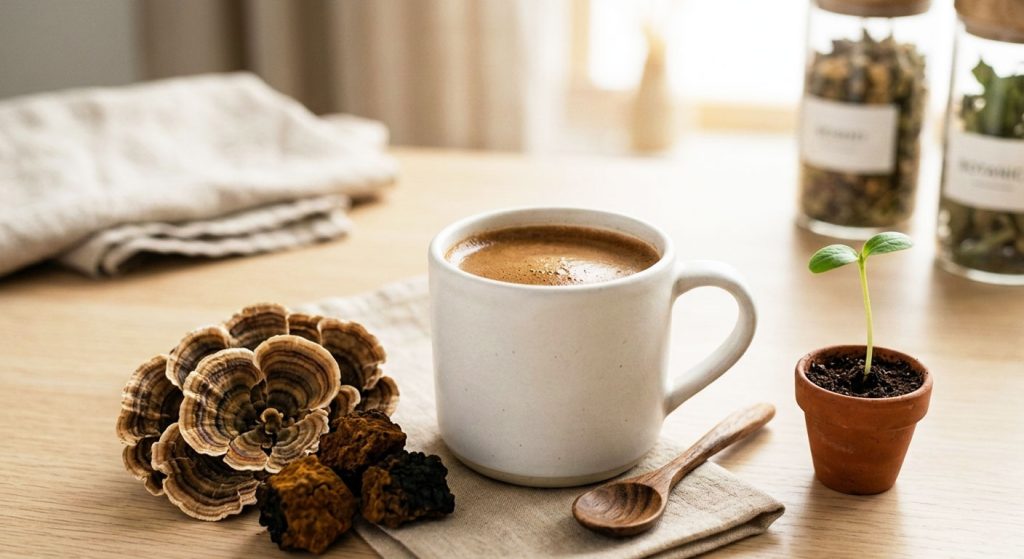
If you’ve been watching the wellness space evolve over the past few years, you already know that 10-in-1 Mushroom Coffee is no longer a fringe curiosity — it’s a category-defining product. What began as an experiment among biohackers and integrative health practitioners has quietly become one of the most searched wellness staples of 2026. And for good reason: this single daily ritual blends the cognitive familiarity of your morning cup with a concentrated stack of adaptogenic fungi scientifically validated to support immunity, longevity, and resilience.
But before we get into the specifics of what makes a well-formulated 10-in-1 blend so compelling, it’s worth understanding the larger cultural and scientific shift driving this movement — because this isn’t a trend. It’s a recalibration.
Beyond the Buzz – Why the World is Shifting from ‘Stimulation’ to ‘Function’ in 2026
For decades, the morning beverage ritual has been almost exclusively about energy. We optimized for wakefulness. We chased the caffeine curve. And while there’s nothing inherently wrong with wanting to feel alert, the conversation in clinical functional medicine has shifted dramatically.
The defining wellness question of 2026 is no longer “How do I feel more awake?” It’s “How do I build a body that performs, defends, and recovers — day after day?” This distinction is everything.
“Stimulation addresses symptoms. Function addresses systems. The smartest consumers are beginning to understand the difference.”
This shift is reflected in hard market data. The global functional beverage market — encompassing adaptogenic drinks, nootropic blends, and immunity-forward formulas — is projected to reach $5.6 billion by 2035, growing at a compound annual rate that consistently outpaces traditional energy drinks. Consumers are actively seeking products that do something beyond delivering caffeine, and mushroom-based coffees are at the front of that demand curve.
What’s particularly interesting from a clinical perspective is that this isn’t being driven by marketing alone. It’s being pushed by a generation of health-literate individuals who’ve done the research, consulted their practitioners, and arrived at the same conclusion: the fungi kingdom offers a pharmacological density that few botanicals can match. Polysaccharides, triterpenoids, ergosterols, and prebiotic fibers — these aren’t buzzwords. They’re mechanisms.
In functional medicine, we talk about the concept of building biological reserve — the capacity your immune system, mitochondria, and microbiome have to respond to stress before symptoms appear. A 10-in-1 mushroom coffee, used consistently, is one of the most accessible tools I’ve seen for doing exactly that.
The Shield: How Chaga, Reishi, and Turkey Tail Support Your Defense System
When we examine the immunity-supporting properties of medicinal mushrooms, the conversation almost always begins with beta-glucans — and for good reason. These long-chain polysaccharides are among the most well-characterized immunomodulatory compounds in natural medicine. They work by binding to specific receptors on immune cells (particularly macrophages, NK cells, and dendritic cells), essentially training your innate immune system to be more responsive and more precise.
Let’s look at the three mushrooms I consider foundational to any serious immune-support formula:
Chaga (Inonotus obliquus)
Chaga grows predominantly on birch trees in cold northern climates, and its antioxidant profile is genuinely remarkable. It contains the highest known ORAC (Oxygen Radical Absorbance Capacity) value of any natural food source — largely driven by its melanin pigments and betulinic acid content derived from the birch bark it metabolizes. In practical terms, this means Chaga is one of the most potent free-radical scavengers available in functional nutrition.
From an immune standpoint, Chaga’s beta-glucan content supports a balanced inflammatory response, which is critical — because chronic low-grade inflammation is the root driver of virtually every major chronic condition we see in modern clinical practice.
Reishi (Ganoderma lucidum)
Reishi has been used in Traditional Chinese Medicine for over 2,000 years, and modern science has given us a much clearer picture of why. Its triterpenoid compounds — particularly the ganoderic acids — have demonstrated significant immunomodulatory and anti-inflammatory effects in peer-reviewed research. What makes Reishi particularly valuable is its adaptogenic quality: it doesn’t simply stimulate or suppress the immune system. It helps regulate it.
For patients dealing with immune dysregulation — whether that’s autoimmune flares, post-viral fatigue, or stress-induced immunosuppression — Reishi is often the first mushroom I reach for. Its calming effect on the nervous system (via its interaction with the GABAergic pathway) is an added benefit that makes it particularly well-suited for evening use, though morning consumption is equally valid.
Turkey Tail (Trametes versicolor)
Turkey Tail may be the most clinically validated mushroom in oncology-adjacent research. Its polysaccharide-K (PSK) extract has been used as an adjunct in cancer protocols in Japan for decades, and its immunostimulating properties have been studied extensively. For everyday immune health, Turkey Tail’s prebiotic fibers and beta-glucan content support the gut-immune axis — a connection that cannot be overstated.
Approximately 70% of your immune tissue resides in the gastrointestinal tract. Turkey Tail helps feed the microbial communities that train and regulate immune cell behavior. In a 10-in-1 blend, it acts as a foundational layer — working below the surface, in the gut, where a great deal of immune education happens.
The synergy between Chaga’s antioxidant density, Reishi’s regulatory intelligence, and Turkey Tail’s gut-immune support creates a layered defense architecture that no single ingredient could replicate.
Longevity in a Cup – The Anti-Aging and Anti-Inflammatory Properties of Shiitake, Maitake, and Mesima
While immunity is the headline story, the deeper conversation in functional medicine is about longevity — not simply living longer, but extending the period of cellular vitality. And this is where Shiitake, Maitake, and Mesima make their most compelling case.
Shiitake (Lentinula edodes)
Shiitake contains eritadenine, a compound that actively supports cardiovascular health by modulating cholesterol metabolism. But from an aging perspective, its most exciting compound may be lentinan — a beta-glucan that has demonstrated potent immunostimulating properties and, in vitro, has shown activity against pathological cellular changes. Shiitake is also a rare non-animal source of ergothioneine, an amino acid that some researchers have nicknamed “the longevity vitamin” for its role in protecting cellular mitochondria from oxidative damage.
Maitake (Grifola frondosa)
Maitake — meaning “dancing mushroom” in Japanese — earns its name. Its D-Fraction beta-glucan extract is among the most researched in functional medicine, with documented effects on blood glucose regulation, immune activation, and inflammatory modulation. For the purposes of longevity, Maitake’s influence on insulin sensitivity is particularly relevant: chronic hyperinsulinemia is now recognized as a significant driver of accelerated cellular aging. By supporting healthy glucose metabolism, Maitake helps reduce one of the most insidious forms of physiological wear.
Mesima (Phellinus linteus)
Mesima is perhaps the least well-known of the three, but it deserves serious attention. Used extensively in Korean and Japanese traditional medicine, Mesima contains hispolon and other polyphenolic compounds with documented anti-inflammatory and antioxidant properties. Emerging research has focused on its potential to inhibit pathological angiogenesis and its role in cellular apoptosis pathways — mechanisms directly relevant to healthy aging and disease prevention.
Perhaps the most striking data point in this space comes from a 2025 cellular study conducted at Emory University, which found that specific mushroom-derived compounds were associated with up to a 50% extension in cellular lifespan markers in model organisms. While translating in vitro cellular findings to human outcomes requires caution, the mechanistic pathways involved — particularly around NAD+ metabolism and mitochondrial function — are consistent with what functional medicine clinicians have observed anecdotally for years.
Taken together, Shiitake, Maitake, and Mesima represent what I think of as the longevity tier of a well-designed mushroom coffee blend: ingredients whose benefits compound quietly over time, operating at the cellular level in ways that don’t always produce immediately perceptible effects but show up in bloodwork, energy resilience, and inflammation markers over months of consistent use.
ShroomTide: Your Daily Dose of Resilience
Understanding the science is one thing. Integrating it into a daily practice is another. This is where ShroomTide enters the picture — a 10-in-1 mushroom coffee formulated specifically for those who want the full-spectrum benefits of functional fungi without sacrificing the ritual and pleasure of their morning coffee.
ShroomTide combines all ten of the mushrooms discussed in this post — Chaga, Reishi, Turkey Tail, Shiitake, Maitake, Mesima, and four additional evidence-backed species — in a single, convenient daily blend. Each batch is third-party tested for beta-glucan content (not just mycelium mass, which is an important distinction many brands obscure), and formulated at doses that align with the clinical research.
What makes ShroomTide different from the dozens of mushroom products flooding the market right now comes down to three things:
- Full-spectrum fruiting body extracts — not myceliated grain filler, which inflates beta-glucan numbers with starch rather than active compounds.
- 10:1 concentration ratios across all mushroom species, ensuring each serving delivers a meaningful therapeutic dose, not a token inclusion.
- Clean formulation — no fillers, no artificial flavors, no proprietary blends that hide dosage. Transparent labeling, verified by independent lab testing.
As a practitioner, I’m also encouraged by the growing body of consumer data emerging from ShroomTide users — particularly around improvements in sleep quality, reduced post-exertion recovery time, and subjective reductions in illness frequency over 90-day periods. These are exactly the outcomes we’d expect to see from consistent beta-glucan loading combined with adaptogenic support.
If you’re ready to move beyond the buzz and build a genuine immunity ritual, ShroomTide is where I’d start. Visit their website to explore the full formulation, read the sourcing transparency report, and find the format — powder blend or capsule — that works best for your lifestyle.
Final Thoughts
The wellness world is full of trends that promise transformation and deliver novelty. Functional mushrooms are not that. They represent one of the most ancient, cross-cultural, and now scientifically validated approaches to human resilience that we have. A 10-in-1 Mushroom Coffee is, in my view, one of the most intelligent ways to integrate that wisdom into the rhythm of modern daily life.
The question is no longer whether mushrooms work. The science has answered that. The question is whether you’re going to take advantage of what nature — and now a generation of rigorous clinical research — is offering you.
Your immune system is a garden. Tend it daily, and it will protect you in ways you won’t notice until the day you need it most.